11th
Mar
Commemorative Coins of Cooch Behar: The Special Tanka of Maharaja Lakshmi Narayan
Coins are not merely instruments of economic exchange; they are also historical documents that reflect the politics, culture, and authority of their time. A small metal coin can reveal a great deal about the era in which it was minted. The coins of the princely state of Cooch Behar hold a special place in Indian numismatics, particularly the distinctive coins issued during the reign of Maharaja Lakshmi Narayan.
Types of Coins: Circulating and Commemorative
-
In general, coins are classified into two main categories:
- Circulating Coins – used for everyday transactions.
- Commemorative Coins – issued to mark special events, royal ceremonies, victories, or significant historical moments.
The focus of this article is a distinctive type of coin introduced during the reign of Maharaja Lakshmi Narayan of Cooch Behar, which appears to have commemorative characteristics.
Historical Background of Coinage in Cooch Behar
Before the establishment of the Cooch Behar kingdom, this region was under the influence of the Bengal Sultanate. As a result, the coins of the Bengal Sultans were widely circulated in the area.
The founder of the Cooch Behar kingdom, Maharaja Biswa Singha (reigned 1523–1554), ruled for a considerable period. However, quite surprisingly, no coins issued in his name have been discovered so far.
His son, Maharaja Nara Narayan, was the first ruler of Cooch Behar known to introduce coins in his own name. These coins were modeled after those issued by Sultan Nasir ud-Din Nusrat Shah of Bengal (1519–1531), following a similar weight standard and design style. At that time, it was common practice for emerging regional rulers to adopt the monetary patterns of powerful neighboring states.
Coinage of Maharaja Lakshmi Narayan
Maharaja Lakshmi Narayan, the son of Nara Narayan, continued the monetary traditions established by his father. Although he was not considered as powerful a ruler as his predecessor, he maintained the circulation of coins under his authority.
One notable feature of his reign was the relatively higher minting of Half Tanka coins, which were used alongside the full Tanka coins.
The Rare Decorated Border Coin
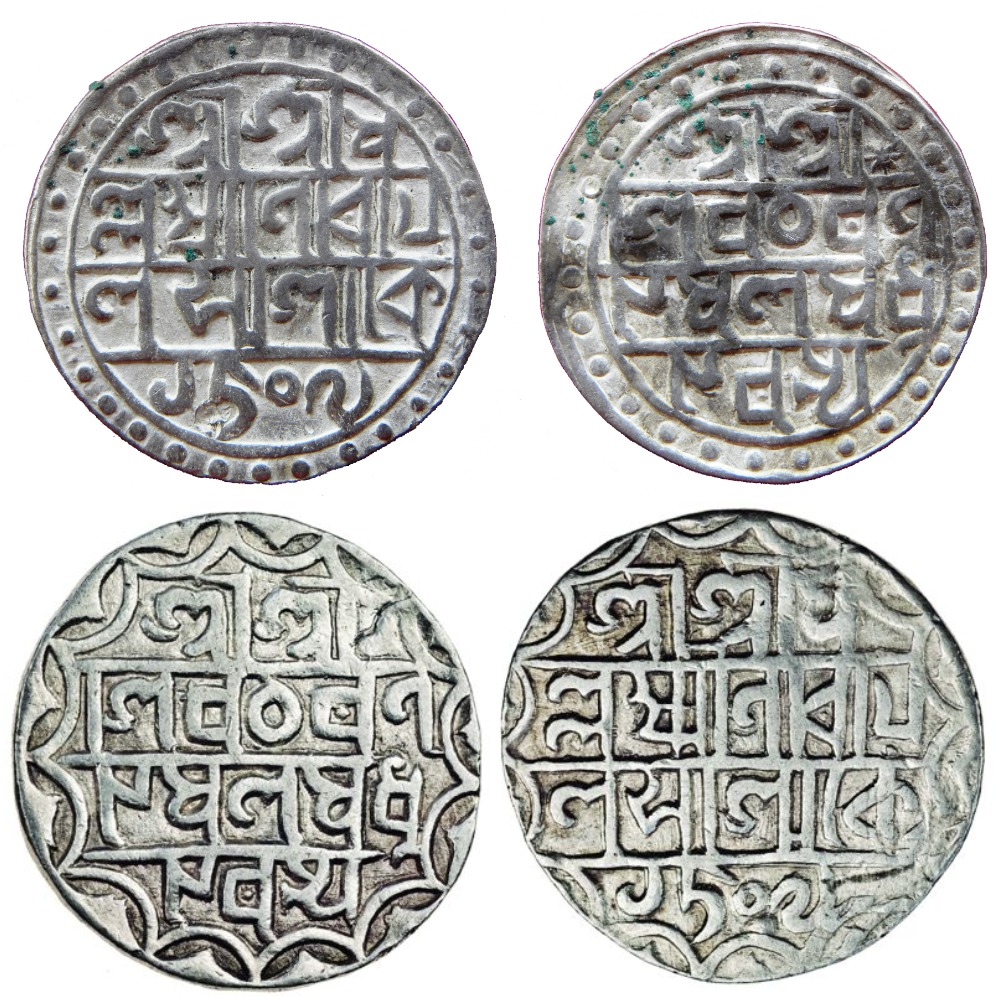
Most coins of this period typically feature a dotted border surrounding the inscriptions. However, a rare variety of Lakshmi Narayan’s coin displays a decorative crescent-shaped border instead of the usual dotted pattern.
So far, four such coins have been documented, and intriguingly, each coin shows a different number of crescent-shaped curves along the border.
-
The known varieties include:
- 12 crescent curves
- 13 crescent curves
- 14 crescent curves
- 15 crescent curves
- Art and design
This variation suggests that these coins may have been issued to commemorate a specific event, ceremony, or royal occasion during the reign of Maharaja Lakshmi Narayan.
Known Examples
-
Among the known examples of these coins:
- A regular Lakshmi Narayan Full Tanka exists in a private collection.
- Another decorated-border Lakshmi Narayan Full Tanka has been documented through Spink Auction, a well-known international numismatic auction house.
These coins are valuable not only as collector’s items but also as important historical artifacts that provide insight into the monetary history of Cooch Behar.
Conclusion
The coins of Cooch Behar offer a fascinating glimpse into the political and cultural history of the region. The decorated-border coins of Maharaja Lakshmi Narayan stand out as rare and intriguing pieces in Indian numismatics..
As research in numismatics continues, further discoveries may help historians understand the exact purpose and historical context behind these unique commemorative-style coins.
Trending Post